

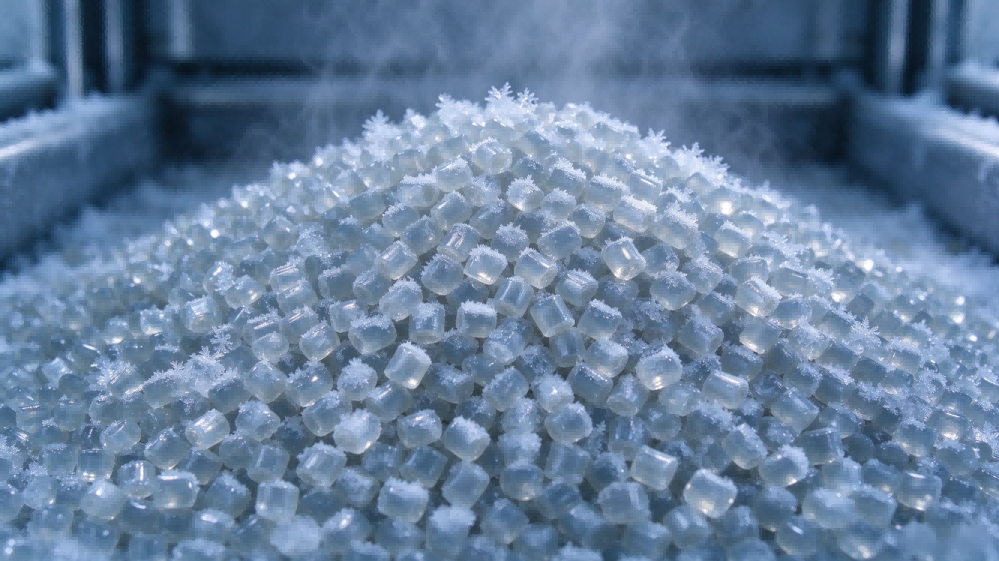
As the Northern Hemisphere approaches winter, a bulletin from the World Meteorological Organization casts a degree of uncertainty over the expected "cold"—while weak La Niña conditions persist, seasonal temperatures in some regions may actually remain above average. For materials engineers, the primary risk lies not in sustained, intense cold, but in volatile, extreme low-temperature spikes; a sudden late-night temperature drop or the embrittlement following a freezing rain event can be enough to cause standard polycarbonate (PC) components to fail in outdoor environments. Cold-resistant modified PC—specifically siloxane-copolymer systems—has emerged as a critical solution for navigating this "climatic uncertainty."
While standard PC is prized at room temperature for its high transparency and impact resistance, it has long been plagued by notch sensitivity and low-temperature embrittlement. Materials science literature indicates that the impact strength of PC drops precipitously when the material contains notches or is exposed to low temperatures. In winter, this physical reality is significantly amplified: whether in the housings of EV charging guns, photovoltaic connectors, electric vehicle battery pack enclosures, or the arms of outdoor drones, the brittle fracture of a PC component at low temperatures can escalate into a safety incident or system downtime. To address this pain point, the modified plastics industry is shifting its approach—moving beyond the conventional method of simply adding toughening agents toward a molecular-level design strategy based on siloxane copolymerization.
From "Tolerance" to "Retention of Toughness": -60°C Becomes the New Benchmark
Guangtong Plastics reports that its core performance metric—notched impact strength at -60°C—has improved by over 30% compared to previous levels. The significance of this breakthrough lies not in merely achieving a lower temperature threshold, but in shifting the competitive focus for cold-resistant polycarbonate (PC) from simple "survivability" to the "retention of impact energy absorption capacity." Around the same time, SABIC’s LEXAN™ EXL copolymer series was marketed with "best-in-class ductility down to -60°C," while maintaining excellent processability (flow) and ease of demolding. A clear convergence of technical approaches has emerged: by incorporating flexible siloxane segments into the PC backbone—a method of "internal toughening" rather than the traditional "external toughening" via elastomer blending—manufacturers can now maintain a balance of toughness, transparency, and flame retardancy, even at extreme sub-zero temperatures.
This technical shift is underpinned by clear market pricing. The global market for PC-siloxane copolymers is valued at approximately $213 million in 2025 and is projected to reach $343 million by 2032, representing a compound annual growth rate (CAGR) of 7.1%. In 2024, global production reached approximately 30,800 metric tons, with an average price of about $6,278 per ton—significantly higher than that of general-purpose PC. This price premium reflects more than just a "cold-resistant" label; it represents how downstream industries value the cost of potential failure. For instance, if a connector in a northern photovoltaic power plant becomes brittle and cracks during winter, the costs associated with repairs and lost power generation far exceed the price difference of the material itself. Similarly, if the casing of an electric vehicle charging gun cracks at -30°C, the resulting erosion of user trust is even harder to quantify.
Winter is not a "downturn" in demand, but rather a "stress-test window" for cold-hardy PCs.
Traditionally, the plastics modification industry views winter as a period when construction activity in northern regions slows down and demand for certain outdoor applications dips. However, the demand curve for cold-resistant polycarbonate (PC) tells a different story: winter is precisely the time when the performance of such materials is most rigorously verified, and when decisions regarding material substitution become most urgent. The experience in the Nordic market is instructive: after a major electric vehicle manufacturer adopted cold-resistant PC for its battery enclosures, the failure rate due to cracking in winter dropped by 92%. The enclosures maintained their structural integrity even when the vehicles were driven on icy, snow-covered roads at temperatures as low as -35°C. These are not merely laboratory figures, but failure statistics accumulated through an entire winter of real-world operation. Similarly, photovoltaic connectors must exhibit both low-temperature ductility and resistance to electrical tracking at -40°C; in this context, the freeze-thaw cycles and snow loads of winter serve as far more demanding screening criteria than the high temperatures of summer.
The year 2026 presents a unique scenario. While a weak La Niña may generally lead to higher-than-average temperature forecasts for parts of the Northern Hemisphere, the resulting increase in temperature variance is likely to trigger more frequent, transient cold spells that fall outside the intended design envelope. For those responsible for material selection, a forecast of higher average temperatures could lead to a false sense of security—increasing the risk that standard, non-modified PC might suffer brittle fractures during sudden cold snaps. In the context of a projected "warm winter," the "insurance value" provided by cold-resistant PC has not diminished; rather, it has been significantly underestimated.
The "cold-weather endurance race" for supply chains is shifting from Europe, the U.S., and Japan toward China.
The supply landscape for cold-resistant, silicone-based polycarbonate (PC) has long been dominated by a handful of multinational corporations. Through patent barriers and extensive expertise in reactive extrusion processes, companies like SABIC—with its EXL series—and Covestro—with specific grades under the Makrolon® brand—have secured a leading position in the global market for ultra-tough, cold-resistant PC. Rather than merely replicating existing products, Chinese manufacturers are taking a different approach: focusing on core process parameters—such as upstream siloxane comonomers, precise formulation optimization, and molecular weight control—to strike a new balance between cost and performance. The mass production of the CH9030P grade by Cangzhou Dahua, combined with Wanhua Chemical’s total PC production capacity reaching the 500,000-ton threshold, signals a shift in China’s role: the country is transitioning from a net importer of specialized cold-resistant PC to a regional supplier capable of offering viable alternatives.
This shift carries global implications: the price barrier for cold-resistant PC may lower, accelerating its adoption in environments that are "cold, if not extreme." This includes applications ranging from electric vehicles and photovoltaic power plants in the Arctic Circle to charging infrastructure in northern China during winter, outdoor lighting enclosures in Central and Eastern Europe, and protective components for 5G base stations in high-latitude North American regions. As cold resistance evolves from an "optional feature" to a "standard requirement," the competitive landscape for modified PC will shift: the focus will no longer be on "who can maintain toughness at -60°C," but rather on "who can reliably deliver that toughness at -40°C while achieving a lower total system cost."
Winter returns to the Northern Hemisphere every year, yet the very definition of "cold-resistant PC" is being rewritten. Forecasts of a weak La Niña serve as a reminder that both the mean and the variance of our climate are shifting. In response, materials engineering is building a "toughness margin" into the molecular chain itself—a buffer against such uncertainty. For any PC component exposed to the outdoors during winter, the true test has never been the average temperature; it is always the coldest night of the year.