

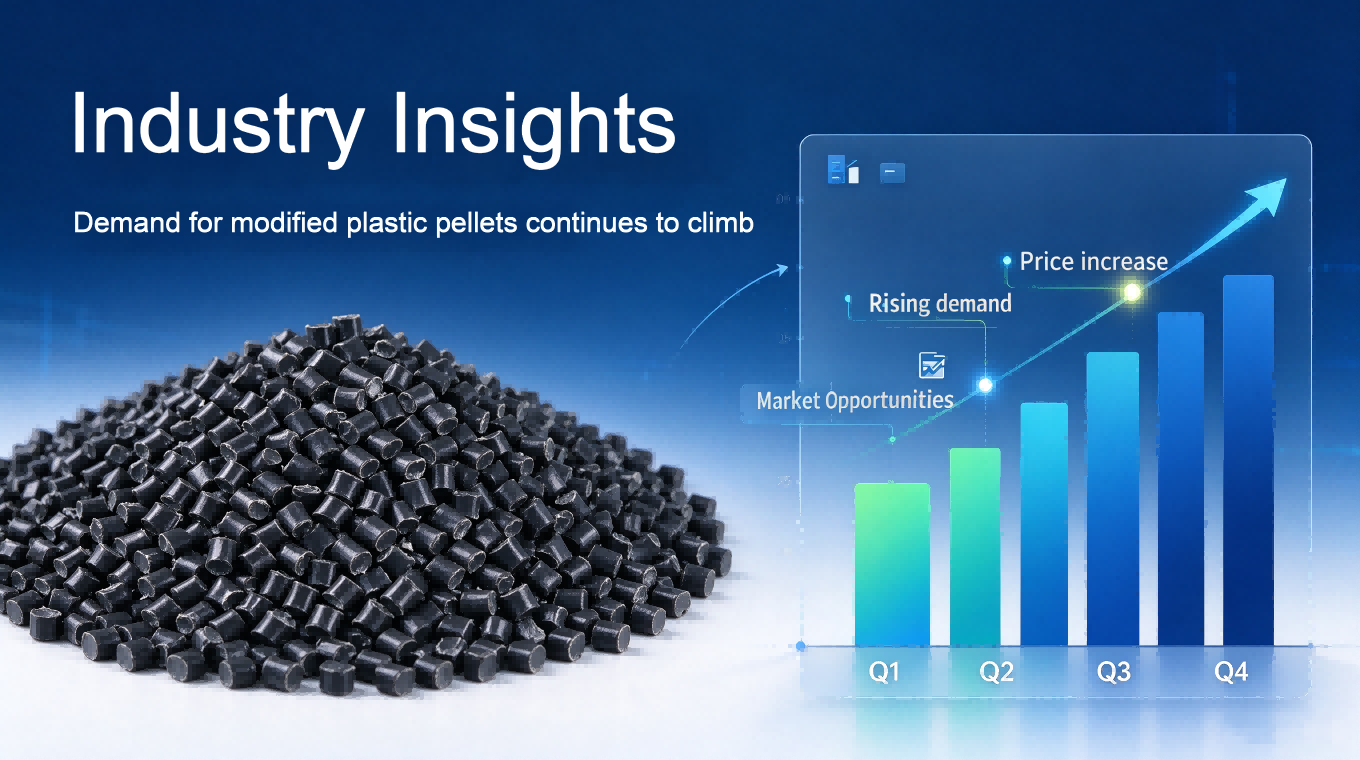
Since 2026, China’s modified plastics industry has accelerated its evolution, characterized by both overall volume expansion and structural divergence. In the first quarter, industry shipment volumes grew by 11.5% year-on-year. The domestic market is projected to exceed 225 billion RMB for the full year, with China’s share of the global market rising to 43.1%. Annual apparent consumption is expected to surpass 28 million tons, with a compound annual growth rate (CAGR) of 8.5%—significantly higher than the global average. Globally, total production of modified plastics is forecast to exceed 120 million tons in 2026, with the Asia-Pacific region accounting for over 62% of both production capacity and consumption; the trend of capacity concentration within Asia-Pacific economies, led by China, continues.
In terms of product structure, the divergence between general-purpose modified plastics and high-end functional materials has become increasingly pronounced. Modified polypropylene (PP) remains the largest product category, supported by steady growth driven by home appliance trade-in programs and the demand for lightweighting in traditional automotive manufacturing. However, this segment faces overcapacity and intense competition, with gross profit margins hovering between only 10% and 18%, leaving shrinking room for profitability among small and medium-sized enterprises. In contrast, products designed for applications such as new energy vehicles, high-end electronics, and robotics—featuring flame retardancy, resistance to extreme temperatures, high impact resistance, and low volatility—have become the core drivers of growth. The domestic substitution of high-end engineering plastics, such as modified polyamide (PA) and polymethyl methacrylate (PMMA), has entered an accelerated phase. Specialized modified materials tailored for high-end sectors—including AI servers and commercial aerospace—benefit from high technical barriers and strong pricing power, making them key profit growth engines for leading industry players. Notably, lightweight, carbon-fiber-reinforced PA/PPS materials, used for the "skeletal" structures of humanoid robot joints, have already been integrated into the product portfolios of major industry leaders.
Nevertheless, the global landscape in 2026 has exerted pressure on the industry, manifesting primarily as a dual squeeze on costs and supply chains. The ongoing instability in the Middle East has caused significant market disruption. The monthly average price of Brent crude oil at one point surpassed $110 per barrel, climbing as high as $120.4 per barrel in April—a surge that systematically drove up the costs of the core petrochemical feedstocks used in modified plastics. By early October, the domestic benchmark price for polypropylene (PP) in China reached 9,933 yuan per ton—a 43.55% year-on-year increase and a cumulative rise of approximately 61% for the year. Meanwhile, the benchmark price for acrylonitrile butadiene styrene (ABS) rose 14.9% year-on-year, marking a year-to-date increase of about 37.2%. As raw materials account for 65% to 70% of the total production cost of modified plastics, the cost pressure has reached a critical threshold. On October 8, Guangtong Plastics announced price hikes: 2,500 yuan per ton for modified PA6; 2,000 yuan per ton for modified PP, PE, PA66, and PBT; 1,500 yuan per ton for modified ABS, PS, and PC; and 1,000 yuan per ton for modified PVC. The company stated candidly that these adjustments were "forced by the situation," as the cost increases had exceeded the company's internal capacity to absorb them.
The industry's competitive landscape is also undergoing an accelerated transformation, driven by shifts in both costs and demand. With substantial revenue, Guangtong Plastics has firmly established itself within the sector, leveraging modified plastics to build a differentiated competitive advantage—notably as a supplier to automotive manufacturers such as BYD. In the first half of 2026, ten major modified plastics enterprises—each with revenues exceeding 1 billion yuan—recorded a combined revenue of 65.594 billion yuan, highlighting a clear trend of market concentration among industry leaders. However, only four of these companies reported net profits exceeding 100 million yuan, indicating a widening gap in both profitability and scale. The homogenized competition among producers of general-purpose plastics is forcing the elimination of low-end capacity. Meanwhile, leading firms—those possessing core proprietary formulations, the ability to secure positions in emerging market segments, and resilient global supply chains—are successfully leveraging this period of industry volatility as an opportunity to expand their market share.