I. Challenges in Weight Reduction
1. Steel is heavy and limits vehicle efficiency; aluminum is costly and hard to process.
2. Plastics and composites cannot balance lightweighting and structural safety.
3. Immature multi-material joining causes cracking, water leakage and noise issues.
II. Safety and Flame Retardancy Challenges
1. Battery materials have poor thermal and fire resistance, risking thermal runaway.
2. Interior and wiring plastics show unstable flame retardancy and become brittle.
3. Exterior parts are fragile in low-speed collisions with high repair costs.
III. Durability and Weather Resistance Challenges
1. Exterior materials fade, crack and age rapidly under harsh outdoor conditions.
2. Chassis components suffer severe corrosion, wear and aging.
3. Temperature changes lead to interior plastic deformation, noise and poor stability.
IV. Material Challenges in the “Three-Electric” Systems
1. Motor and ECU housings lack sufficient heat dissipation and electromagnetic shielding.
2. Insulation materials have insufficient temperature and voltage resistance, causing leakage risks.
3. Battery sealing materials have poor airtightness and aging resistance, leading to failure.
V. Mass Production and Cost Challenges
1. High-end and imported materials increase costs and reduce profit margins.
2. Disordered material supply chains hinder procurement and batch consistency.
3. Low molding yield and high scrap rates elevate manufacturing costs.
VI. Environmental and Recycling Challenges
1. Interior plastics exceed VOC limits and fail environmental standards.
2. Thermoset composites are non-recyclable and create solid waste pressure.
3. Unstable recycled material quality restricts large-scale structural application.
VII. Challenges in Adapting to New Energy Vehicle Iterations
1. New materials lack standard validation data, leading to long certification cycles.
2. Insufficient dedicated die-casting materials cause structural and surface defects.
Solution:
I. Lightweighting Structure
GF/CF modified materials deliver high rigidity, creep and impact resistance for lightweight metal replacement, while improving multi-material assembly to avoid noise and separation.
II. Fire Safety and Protection
1. Battery materials achieve halogen-free V0 flame retardancy, high temperature and puncture resistance against thermal runaway.
2. Interior and harness materials maintain both flame retardancy and toughness for impact safety.
III. Outdoor Durability and Aging Resistance
1. Exterior materials resist UV, salt spray and aging to prevent fading and cracking.
2. Chassis grades withstand oil contamination and abrasive wear.
3. Improved thermal stability eliminates interior warpage and abnormal noise.
IV. Compatibility with Electric Powertrain Systems
1. Housing materials support high-voltage insulation and electromagnetic shielding.
2. Sealing materials ensure long-term airtightness and aging resistance.
3. Thermally conductive grades enhance heat dissipation.
V. Cost Reduction in Mass Production
1. Stable batch fluidity and shrinkage reduce injection defects for large integrated parts.
2. Tiered material grades lower overall vehicle material costs.
VI. Environmental Compliance and Recycling
1. Low-VOC, low-odor interior compounds meet automotive cabin standards.
2. Recyclable thermoplastics with standardized recycled content support circular manufacturing
Factory strength:
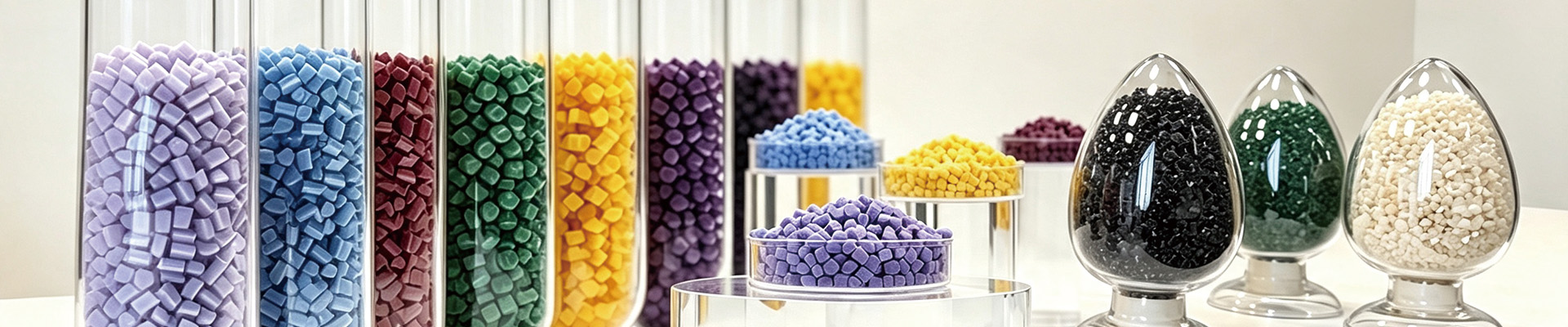
I. Customizable Functional Modifications (All pellet grades can be formulated to meet specific needs)
1. Flame Retardancy: Halogen-free UL94 V-0 grade, low smoke, non-dripping and non-toxic.
2. Lightweight & Reinforcement: GF/CF/Long glass fiber reinforced formulas for high rigidity, creep resistance and fatigue resistance.
3. Interior Environmental Performance: Low odor, low VOC, low fogging and low emission for vehicle interior standards.
4. Environmental Durability: Excellent UV aging resistance, thermal cycle stability (-40°C~180°C+) and chemical/oil resistance.
5. High-Voltage Electrical Performance: High tracking resistance and insulation strength; optional anti-static and conductive modification.
6. Molding & Aesthetic Upgrade: Low fiber exposure, high flow for thin-wall injection molding, scratch resistance, and paint-free metallic/pearlescent/matte finishes.
II. Qualifications and Implementation Support Services
1. Authorized Certifications: ISO9001, UL Yellow Card, RoHS, REACH for customer qualification and project approval.
2. Customized Material Solution: Provide BOM-based material selection, metal-to-plastic lightweight replacement and cost-down analysis.
3. Full-Cycle Service: Sample testing, pilot production and mass delivery; formula & process optimization to solve warpage, shrinkage, cracking and floating fiber defects.
Related products
1. Battery pack housing / Top cover / Module bracket / End plate
Key attributes: Halogen-free V0 flame retardancy, impact resistance, high toughness, low density (lightweight), chemical resistance, 180°C heat resistance, corrosion resistance
Materials: Glass fiber-reinforced PC/ABS; flame-retardant, long glass fiber-reinforced PP
2. Battery thermal/fire insulation barriers, explosion-proof buffer pads
Key attributes: Non-melting, drip-resistant
Materials: Flame-retardant, glass fiber-reinforced PA66
3. Motor housing, stator frame, end caps, cooling structural components
Key attributes: Flame retardancy, electrical insulation, heat resistance
Materials: PA66+GF30, PA4T
4. Automotive interior systems (instrument panels, door panels, center consoles, pillars, armrests)
Key attributes: Low VOC, low odor, low fogging, scratch resistance, whitening resistance
Materials: Long glass fiber-reinforced PP, PC/ABS alloy, reinforced PP, flame-retardant PP
5. Automotive lighting and autonomous driving sensor components
Key attributes: High-temperature dimensional stability, UV resistance (no yellowing), thermal shock resistance (no cracking)
Materials: Optical-grade UV-resistant PC granules, infrared-transparent PC